
Vinyl Wrap vs Paint: Which Is Better for Your Vehicle?
Vinyl Wrap vs Paint Job: Which Is Better for Your Vehicle?

Quick answer
For most drivers, a high-quality vinyl wrap is the better choice over a paint job. Wraps cost less ($2,500–$9,000 vs $8,000–$15,000+), preserve your factory paint and resale value, can be removed or changed, and offer finishes that paint cannot replicate (chrome, color shift, brushed metal). Paint lasts longer (10+ years vs 5–7 for wrap) and is preferable for very long-term ownership or if you want a permanent change. The right answer depends on how long you'll own the vehicle and what you're trying to achieve.
Vinyl wrap vs. paint at a glance
FactorVinyl WrapPaint JobTypical cost$2,500–$9,000+$8,000–$15,000+ (quality)Lifespan5–7 years10–20+ yearsReversibilityFully reversiblePermanentTurnaround time5–10 days3–6 weeksProtects original paintYesN/AResale impactNeutral to positiveCan be negative for non-factory colorsFinish optionsWider (chrome, color shift, matte, satin)Limited to paintable finishesRepair after damageRe-wrap individual panelBody shop work, color matchingMaintenanceHand wash, no automatic brushesStandard car care
The fundamental difference
A vinyl wrap is a thin film applied over your existing paint. Quality vinyl is roughly 3–4 mil thick (about the thickness of a credit card divided in 50). It conforms to body lines, wraps into panel edges, and is held in place by adhesive that activates fully a few weeks after installation.
Paint is a chemical coating applied directly to the body panels. A proper paint job involves stripping or sanding the existing paint, applying primer, color base coat, and clear coat — usually multiple thin layers each. Quality paint becomes part of the vehicle.
That foundational difference is why every other comparison below — cost, durability, reversibility — comes out the way it does.
Cost: wrap wins by a wide margin (for now)
Quality vinyl wraps in Denver typically run $2,500–$6,500 for a standard color change, with specialty finishes climbing to $9,000+. A quality paint job at a reputable shop typically starts around $8,000 and reaches $15,000–$20,000+ for premium work or exotic vehicles. Cheap paint jobs ($1,500–$3,000) exist but look like cheap paint jobs — often within months.
For a standard color change, you can expect to pay roughly half to one-third the price of a comparable-quality paint job. That gap doesn't really close even at the highest tiers — a $9,000 specialty wrap is significantly more accessible than a $20,000 custom paint job.
But cost-per-year tells a different story over a long enough timeline. A 6-year wrap at $4,500 costs $750/year. A 15-year paint job at $12,000 costs $800/year. They're closer than they look on the sticker.
For full pricing breakdowns, see our color change wrap cost guide for Denver.
Durability and lifespan
This is where paint pulls ahead.
Quality vinyl wrap lifespan: 5–7 years in Colorado conditions, with proper care. Premium films from 3M, Avery Dennison, and KPMF can hit the higher end. Cheap film fails much faster (1–3 years).
Quality paint lifespan: 10–20+ years before significant fading, oxidation, or clear coat failure. Modern automotive paint is very durable when applied correctly.
What this means in practice: if you're keeping a vehicle 5–7 years, both options will look similar at trade-in time. If you're keeping a vehicle 10+ years, paint will likely outlast a wrap and you may need to redo or remove the wrap before you sell.
A side note: wrap protects the original paint underneath. After 7 years of driving in Colorado UV, a wrapped vehicle's underlying paint is often in better condition than the comparable unwrapped vehicle's because it was shielded from sun, road salt, and minor impacts.
Color and finish: wrap wins on options, paint wins on perfection
Wrap offers finishes paint cannot:
- Chrome — true mirror-like chrome finishes that paint cannot replicate
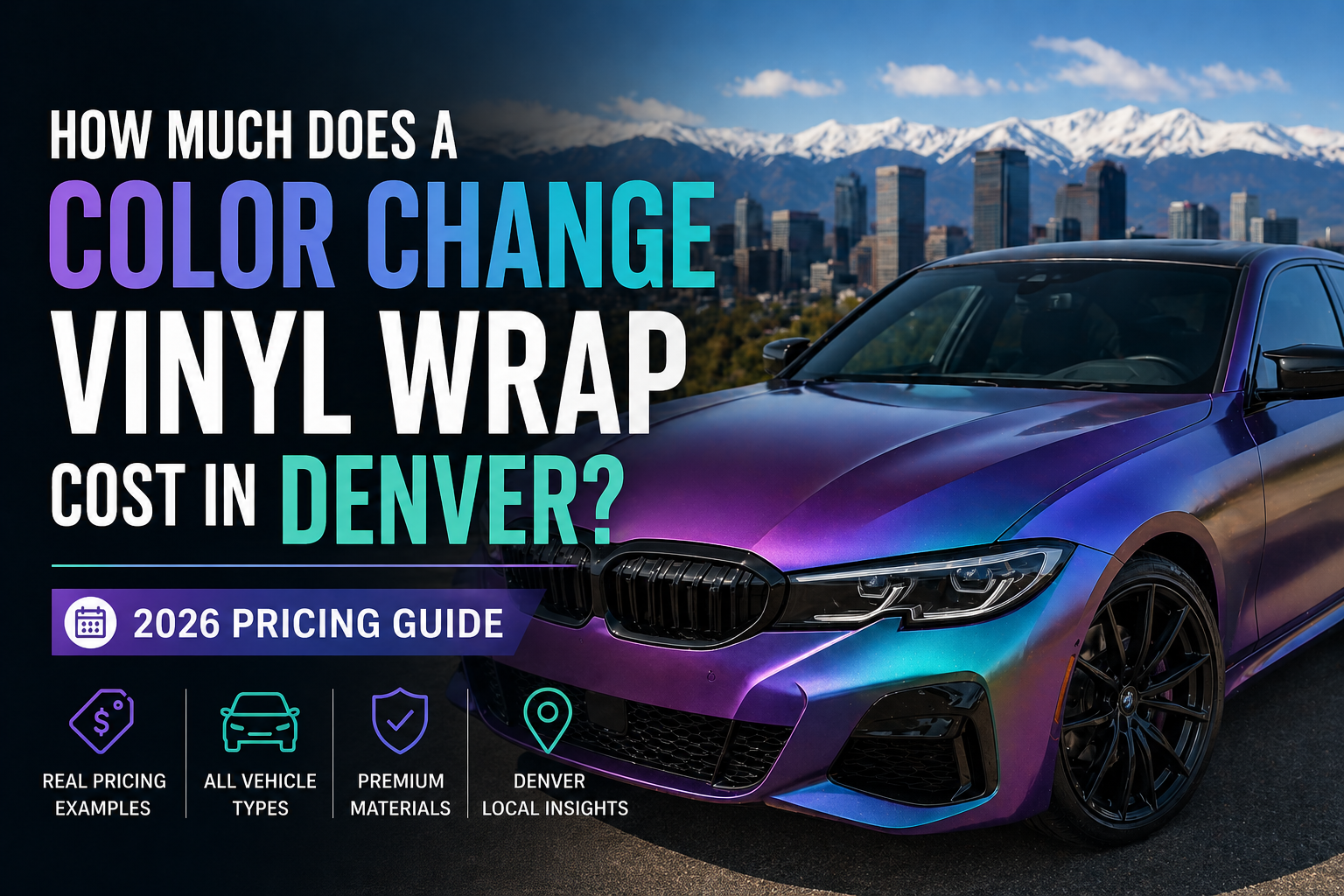
- Color shift / chameleon — colors that shift based on viewing angle (purple to teal, blue to gold)
- Brushed metal — looks like brushed aluminum or stainless steel
- Carbon fiber texture — accurate carbon weave appearance
- Pearl and iridescent — multi-layer pearl effects
- Matte and satin — without the maintenance challenges of matte paint
For drivers who want something distinctive, wrap opens doors paint cannot. A satin pearl white Tesla, a chrome Lamborghini, or a brushed-aluminum Bronco are all wrap territory.
Paint offers a finish wrap cannot fully replicate:
- True depth — paint has layers (base coat, clear coat) that catch light differently than a single film layer
- Custom designs — multi-color fades, airbrush work, complex graphics that go beyond what wrap can produce
- Perfect compound curves — extreme curves, deep indents, and complex body lines are easier to paint than to wrap
- The "wet look" of high-end clear coats with no panel seams
For high-end show cars or vehicles where the finish itself is the centerpiece, custom paint can outperform wrap visually. For nearly everything else, modern vinyl looks indistinguishable from paint at conversational distance.
Reversibility and resale value
Wrap is fully reversible. A quality vinyl wrap installed by a professional and removed within its rated lifespan comes off without damaging the original paint. This has two big implications:
- You can return to factory color before selling, which preserves resale value (especially for premium vehicles in popular colors)
- You can change colors every few years without committing to one forever
Paint is permanent. A custom-painted vehicle is committed to that color until repainted, and:
- Non-factory colors typically hurt resale value. A factory white Tesla resells for more than a custom-painted Tesla, even if the paint is professionally done. Many luxury and exotic buyers specifically want factory colors.
- Repainting back to factory costs another $8,000–$15,000+
This is one of the most underrated reasons drivers in Denver — especially Tesla, BMW, Porsche, and Audi owners — choose wraps. They get the look they want without locking in a resale hit.
Turnaround time
Wrap: 5–10 days for a full vehicle. Most of that is install time, not curing. You're without the car for one to two weeks.
Quality paint: 3–6 weeks. Properly stripping or sanding existing paint, applying primer, multiple color coats, and clear coat — with proper drying and curing time — takes serious shop time. You're without the car for a month or more.
For drivers who can't be without their vehicle for 3+ weeks, wrap is the obvious choice. For drivers planning around extended time off, paint becomes more feasible.
Maintenance differences
Wrap maintenance is more restrictive than paint:
- No automatic brush car washes (brushes lift edges over time)
- Hand wash with pH-neutral soap recommended
- No high-pressure washing close to seams or edges
- No abrasive polishes or compounds
- No waxing (most wraps don't need it; some can take ceramic spray sealants)
This isn't difficult, just different. Owners who have been hand-washing their cars already won't notice the change. Owners who run their cars through a Quick Quack twice a month will need to adjust.
Paint maintenance is standard:
- Any car wash type works, though hand washing extends paint life
- Wax or sealant applications recommended every few months
- Compound and polish acceptable for swirl removal
- Clear coat protects against many minor impacts
For owners who want zero maintenance changes, paint wins this round.
Damage repair
Both options have repair pathways, but they work differently.
Wrap damage: an individual panel can be re-wrapped if it's torn, scratched, or damaged. A door re-wrap might run $300–$800 depending on the panel and finish. The downside is that color matching can be tricky with wraps that have aged — a fresh panel of the same vinyl on a 4-year-old wrap may look slightly different.
Paint damage: body shop repair, which involves color matching and potentially repainting adjacent panels for a seamless blend. Generally costs more per repair ($800–$2,500+ per panel for quality work), but no aging concerns with the surrounding paint.
For minor everyday damage (rock chips, parking lot scrapes), wrap actually has an advantage — the film often absorbs damage that would have hit the paint underneath, and individual panels are easier to fix than to repaint.
Why Colorado affects the wrap-vs-paint decision
A few Colorado-specific factors push more drivers toward wrap than they would in other markets:
- UV at altitude is brutal on paint. At 5,280 feet, UV exposure is roughly 25% stronger than at sea level. Custom paint fades faster here. A wrap absorbs that UV and protects the underlying factory paint, then can be replaced when it ages.
- Mag chloride and winter chemistry. CDOT's liquid de-icer is corrosive and bonds to paint. It accelerates paint oxidation and clear coat failure. A vinyl wrap acts as a sacrificial layer.
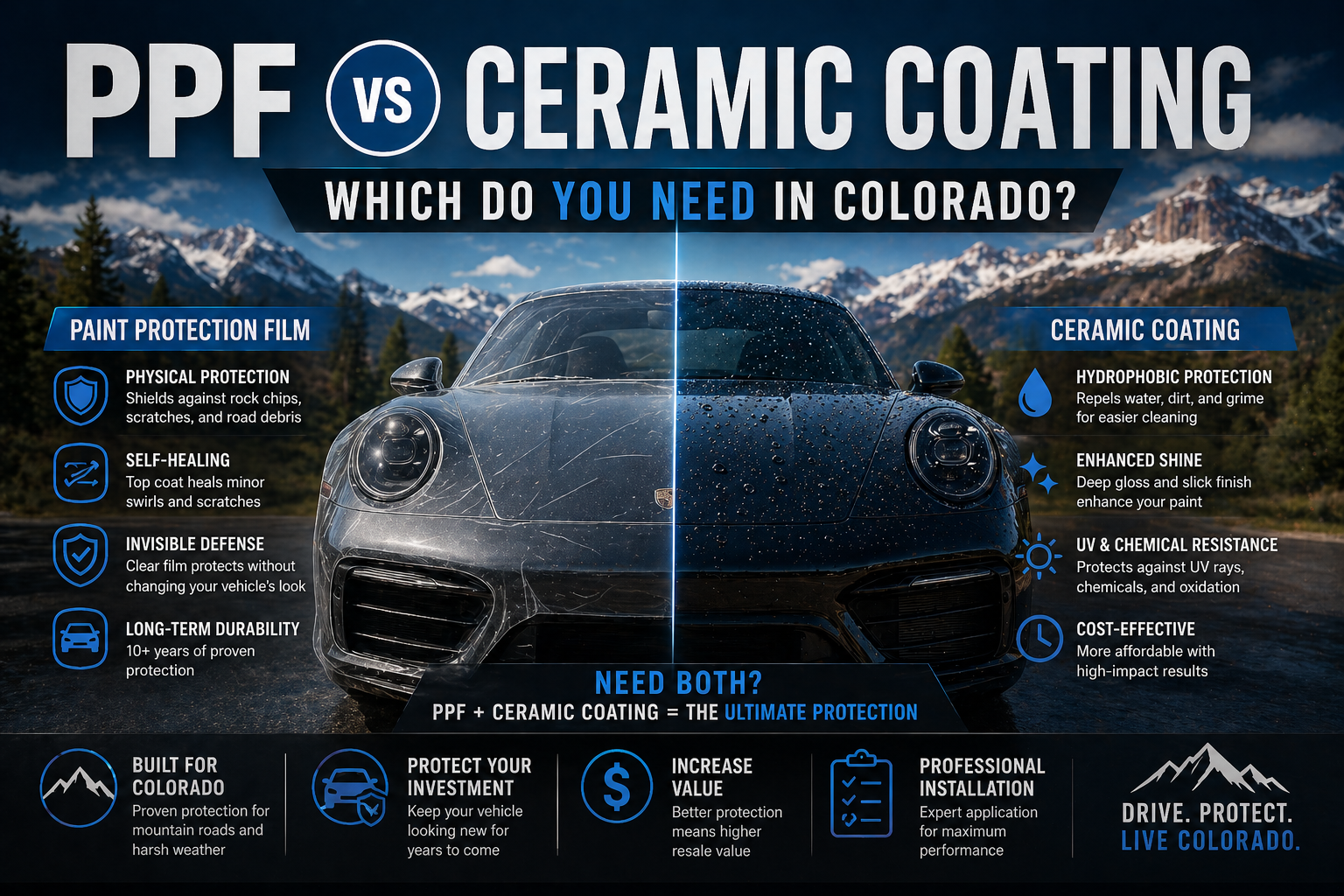
- Mountain travel = rock chips. I-70 and the high-country highways are paint-killers. Even with a wrap, rocks still chip — but the chip hits the vinyl, not your factory paint. Combine with PPF on impact zones for the strongest possible setup.
- Hail. The Front Range is one of the worst hail corridors in the country. Vinyl provides minor hail protection (helps with smaller hail) but won't save you from a major storm. Paint offers no impact protection.
- Climate swings affect paint chemistry. Denver swings from 0°F to 100°F over a year. Modern paint handles this fine, but cheap paint jobs crack under the temperature stress. Wrap, by contrast, expands and contracts with the panel naturally.
Which option makes sense for which kind of driver
Choose wrap if:
- You want to keep the vehicle 3–8 years
- You want to change the color but might want to return to factory
- You're driving a Tesla, BMW, Audi, Porsche, or other premium vehicle where resale matters
- You want a finish paint can't replicate (chrome, color shift, brushed)
- You can't be without the vehicle for 3+ weeks
- You want to protect factory paint underneath
- Your budget is under $7,000 and you want quality work
Choose paint if:
- You're keeping the vehicle 10+ years and want maximum lifespan
- You want a custom design (graphics, fades, multi-color work) that wrap can't replicate
- You want zero maintenance changes from how you currently care for the car
- You want a repaint to factory color (not a color change)
- You have $10,000+ to invest and 4–6 weeks of vehicle downtime
- Your existing paint is significantly damaged and a fresh repaint would also fix surface issues
Choose color change PPF if:
- You want the look change plus full paint protection
- The vehicle is high-value enough to justify $7,000–$12,000+
- You want the longest-lasting color change option (10-year typical lifespan)
We cover this third option in detail on our color change PPF wraps service page.
Common myths about wrap vs. paint
"Wrapping a car damages the original paint." False if the install and removal are done properly. Damage typically happens from poor-quality vinyl, improper removal (not using heat), or wrap left on far past its lifespan. Quality vinyl removed correctly leaves factory paint intact.
"Wrapped cars look obviously wrapped." Not for quality work. From conversational distance, a quality wrap looks identical to factory paint. Even up close, only experienced installers can spot the seams on a well-done wrap.
"Paint is always more durable than wrap." True for quality paint vs. quality wrap on a long enough timeline. Not true for cheap paint jobs, which fail faster than any quality wrap. A $2,000 paint job will look worse than a $4,500 wrap after 3 years.
"You can't insure a wrapped car." False. Most insurers cover wrapped vehicles normally. Some may need notification of the modification; comprehensive coverage typically applies to wrap damage just like paint damage.
"Wraps fade fast in Colorado." True for cheap film. False for quality 3M, Avery, or KPMF film, which is engineered for UV stability and hits the 5–7 year range even in Colorado.
"You can't park a wrapped car in the sun." False. Quality wraps are designed for daily outdoor use. Long-term garaging extends the life of any finish — wrap or paint — but you don't need to baby a wrap.
Frequently asked questions
How long does a vinyl wrap last on a daily driver in Colorado? 5–7 years is typical for quality wraps with proper care. Premium films can hit 7+ years.
Can I wrap over an existing wrap? Generally not recommended. The original wrap should be removed first to ensure proper adhesion and a clean finish.
Will a wrap protect against rock chips? Partially — it absorbs minor impacts that would have chipped paint, but it's not designed for impact protection. For real chip protection, look at paint protection film (PPF) on the front-end impact zones.
Can I wrap a leased vehicle? Yes, and it's actually a good move on leases — the wrap protects the factory paint, can be removed before lease return, and gives you a custom look without a lease violation.
How much paint correction do I need before wrapping? The paint underneath should be in decent condition — clean, free of major peeling, and ideally without deep scratches. Light swirls are fine because vinyl conforms over them. Significant defects need correction first.
Does wrap come off cleanly years later? Yes, when removed by a professional within the rated lifespan. Heat is used to soften the adhesive, and the film comes off without damaging the underlying paint.
Can a wrap be polished or compounded? No — abrasives damage vinyl. Wrap care relies on careful washing and ceramic spray sealants if extra protection is desired.
What about ceramic coating on a wrap? Yes, ceramic coatings designed for vinyl exist and work well. They make wraps easier to clean and add UV protection. Ask your installer about coating options before deciding.
Get expert guidance for your specific vehicle
The wrap vs. paint decision depends on your specific vehicle, ownership timeline, and goals. We've worked on hundreds of vehicles across both options and can walk you through what makes sense for yours. Free, no-pressure consultations at Summit Customs in Commerce City — bring the car by or send photos with your timeline and goals.
Get a free wrap consultation →
Or call us directly: 303-499-1164
Summit Customs is a 3M Pro Shop Dealer based in Commerce City, serving Denver, Aurora, Boulder, Highlands Ranch, Thornton, and the entire Front Range.
Recent Posts